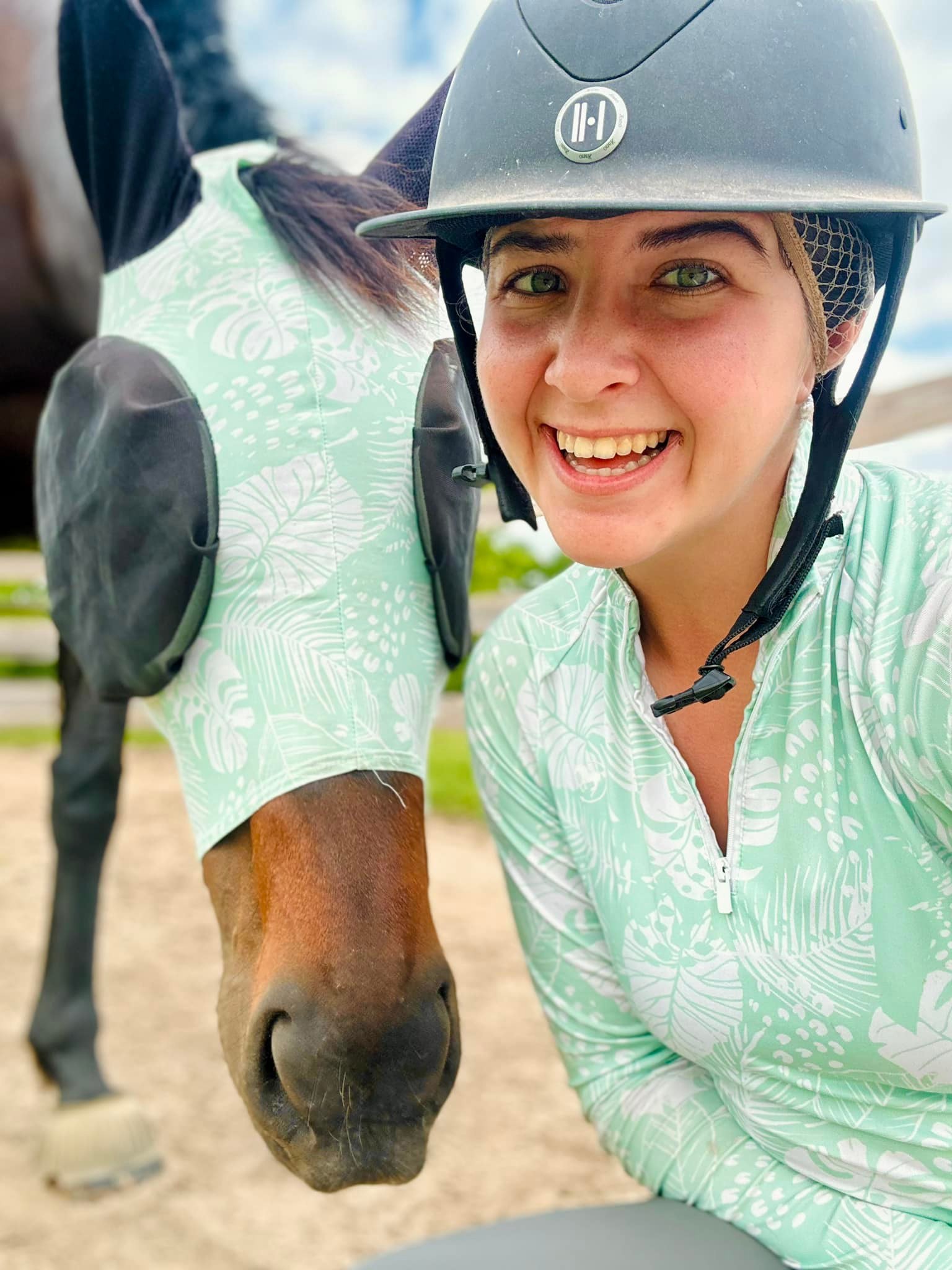
You got back on. That’s the part everyone celebrates. What nobody tells you is that getting back on is the easy part — and that the months after a fall can feel lonelier and more confusing than the fall itself.
You’re riding, but you’re not riding. You’re in the tack, your body doing the mechanics, and your brain is somewhere else entirely — scanning the fence line, bracing for the spook, rehearsing the disaster before it happens. You’re managing. You’re not trusting. And you’re starting to wonder if you ever will again.
This is not a mindset problem. This is your nervous system doing exactly what it was designed to do.
What Actually Happens to Your Brain After a Fall
When you hit the ground — especially if it was sudden, painful, or scary — your nervous system files it as a threat. Not just a memory. A threat pattern with a physical signature attached to it. Heart rate, breathing, muscle tension, tunnel vision. Your body learned that horses are dangerous in a way it hadn’t quite believed before, and now it’s doing its job: keeping you alive by making you hypervigilant.
The problem is that hypervigilance looks a lot like bad riding. You grip. You brace. You stop breathing at the canter. You anticipate the spook so hard that you actually create it — your horse feels the tension in your seat before you feel it in your hands, and he does what horses do: he responds to the conversation your body is having with him.
And then you think: See, I knew something was going to happen.
That loop is not a character flaw. It’s a nervous system stuck in threat mode. The answer is not to think your way out of it. You can’t logic your nervous system back to calm.
The Mistake Most Riders Make
The instinct — especially for competitive riders — is to push through. Ride the scary fence. Go to the show. Get back to normal as fast as possible, because normal is where you’re supposed to be.
I understand that instinct completely. I’ve lived it. But pushing through a dysregulated nervous system doesn’t build confidence. It builds tolerance for suffering, which is a different thing.
What I see most often in my work with riders is this: they compress the timeline so aggressively that they never actually process what happened. They ride scared for long enough that scared starts to feel like their baseline. And then they come to me six months post-fall wondering why they still can’t relax at the canter, not realizing they never gave their system a real chance to recover.
Confidence is not the absence of fear. It’s a nervous system that has enough resources to stay regulated when fear shows up.
You build that through slow, successful repetition — not through white-knuckling your way over the fence that got you.
A Framework That Actually Works
This isn’t a seven-step plan. It’s more like a set of principles I come back to with every rider who’s working through something like this.
Start at the bottom of the ladder
Wherever you are right now, go one rung lower. If you’re tense at canter, work at trot until trot is genuinely calm — not just manageable, but calm. If you’re fine at trot but dread the jumping field, spend three sessions just walking through the jumping field on a long rein before you pick up a pole.
The question to ask yourself is: Can I breathe here? If the answer is no, you’re not at the right rung yet.
Make breathing non-negotiable
This sounds simple because it is, and it’s also the thing riders skip most often. Before you ask for anything — a transition, a turn, an approach — take one full exhale. Let your ribcage drop. Feel your seat bones make contact with the saddle.
Your horse will feel that exhale. It costs you nothing. It signals to your nervous system that the threat has passed. Do it before every fence, every corner, every moment that tends to spike your anxiety.
I’ve talked about the mechanics of this more on The Elevated Equestrian podcast — specifically how breath timing affects your horse’s back in canter — but in the context of confidence rebuilding, breath is less about biomechanics and more about regulation. It’s a direct line to your autonomic nervous system.
Define a success criterion that isn’t “I wasn’t scared”
Fear is information. It doesn’t mean things are going wrong. It means your nervous system is paying attention. A successful ride is not one where you felt no fear — it’s one where the fear didn’t run the show.
Set your bar for the day as something concrete and achievable: “I will trot the outside line on a loose rein.” Not “I will feel confident.” Feelings follow action over time. Start with actions.
Work with a trainer who can read your system, not just your position
There’s a specific skill set involved in coaching a rider through post-fall confidence work, and it’s different from coaching general position or technical skills. You need someone who notices when your breathing changes, who can adjust the ask in real time based on what your body is doing, and who won’t pressure you to perform before your system is ready.
This matters especially for hypermobile riders, who often have a harder time reading their own physical tension — their joints can absorb a lot of bracing before it becomes obvious in the saddle, which means they can be more dysregulated than they realize and not know it until something goes sideways.
Stop measuring progress in weeks
Your nervous system doesn’t care about your show calendar. Some people come back from a significant fall in two months. Some take a year. Both are normal. The timeline depends on the severity of the fall, your history with falls before this one, how much support you’re getting, and a dozen other variables that have nothing to do with how tough or committed you are as a rider.
What matters is the direction of the trend. Are the good moments getting more frequent? Is your baseline moving? That’s what you’re tracking.
When You Have a Bad Day
You will have days that feel like you’ve gone backward. You’ll have a ride that scares you more than the one three weeks ago did, and your brain will tell you that you’re getting worse.
You’re probably not. You’re just having a bad day.
Nervous system recovery is not linear. It looks like two steps forward, one step back, three steps forward, one step sideways, and then one day you realize you cantered that whole course without bracing once. That day doesn’t announce itself. It just happens.
Don’t make decisions about your long-term trajectory based on your worst week.
The Work Is Real
I want to be clear about something: this process is actual work. It is not just riding your horse and hoping things get better. It’s deliberate, targeted, and it benefits enormously from outside eyes — someone who can see what’s happening in your body before you feel it, adjust the session accordingly, and help you build a ladder that matches where you actually are, not where you think you should be.
The riders I see make the most progress are the ones who stop performing recovery and start actually doing it. They’re willing to spend three sessions at the trot. They’re willing to say “this fence is one step too big for me today.” They’re willing to be a beginner at confidence, even when they’re not a beginner at riding.
That humility is not weakness. It’s the most efficient path back.
If you’re working through a fall and want support that accounts for your whole nervous system — not just your position — I work with riders at all levels through private lessons and clinics in Aiken, SC and on the road. Come with whatever you’ve got. We’ll figure out where the bottom of your ladder actually is and build from there.