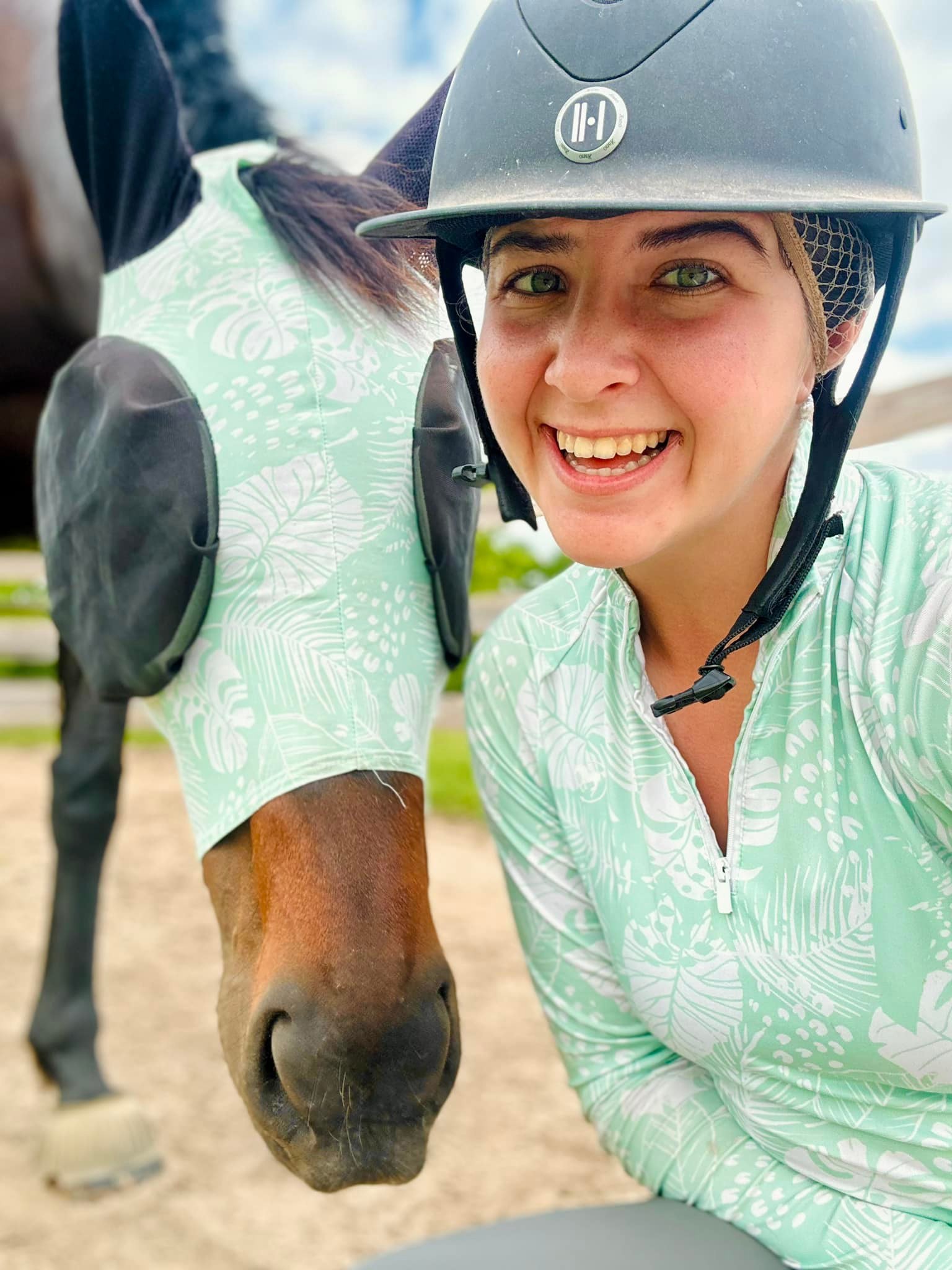
Your horse passed the lameness exam. His back is soft. He loaded on the trailer without a second glance. You get on, and somewhere between the mounting block and the first corner, your hands tighten, your seat stiffens, and you start scanning for the thing that is about to go wrong. Except nothing goes wrong. He is fine. You are the problem — and recognizing that is actually the most useful thing that can happen to you.
This is not a character flaw. It is a nervous system pattern, and it has a specific mechanism. Understanding that mechanism is where real change starts.
Why Your Brain Is Running a Loop That No Longer Applies
Your nervous system does not update automatically when circumstances change. It learns through experience and repetition, and it is profoundly conservative. If you had a horse fall through a fence, a horse who bolted on the trail, or a horse who was in chronic pain for two years while you tried to figure out what was wrong — your nervous system logged that. It filed it under “riding means danger is possible.” And it will keep filing new rides under that same heading until you give it a sustained, embodied reason not to.
The key word there is embodied. Reading about nervous system regulation does not rewire this. Telling yourself to relax does not rewire this. What rewires it is repeated physical experience of safety — of breathing all the way out in the saddle, of feeling your seat bones drop, of noticing that your horse is, in fact, moving quietly beneath you and nothing bad is happening.
The trap most riders fall into is cognitive. They try to think their way to calm. They build a case: “He was fine yesterday, the vet cleared him, I have no reason to be scared.” All true. The nervous system does not care. It is not listening to your argument. It is listening to your body — and if your body is braced, it concludes that bracing is appropriate.
The Specific Physical Pattern to Watch For
Fear in the rider does not show up as one thing. It shows up in layers, and they compound each other.
First, the breath goes. Not a sharp gasp — most riders do not notice it happening. It is a subtle hold, usually right after the first stride or the first moment of uncertainty. The inhale happens, the exhale does not complete, and now you are riding with your diaphragm in a partial brace.
Then the hands come alive. Not necessarily pulling — sometimes it is a squeeze, a micro-fixation, a contact that is slightly too present. The horse feels it. Even a well-trained, settled horse will slightly elevate through the base of the neck in response to a hand that is asking a nervous question.
Then the hip flexors load. This is the one that locks the whole system. When you brace in anticipation of something going wrong, the hip flexors engage as a protective reflex. Your pelvis tips, your lower back stiffens, and your ability to absorb the horse’s movement through your seat disappears. You are now sitting on top of the horse instead of with him.
And then the horse changes. Not because he is reactive or poorly trained — because he is honest. He is responding to the conversation your body is having. His back comes up a degree. His tempo gets slightly inconsistent. And you read that as confirmation: something is off. The loop closes. You were right to be worried.
The horse was fine. You made him briefly less fine, and then you took that as evidence that your original worry was justified.
How to Interrupt the Loop While You Are Actually Riding
You cannot stop the pattern by noticing it intellectually. You have to interrupt it at the body level, which means you need physical anchors — specific things you do with your body that signal to your nervous system that the threat assessment is off.
The exhale before the transition. Not during, not after. Before you ask for anything — a downward transition, a corner, a circle — exhale fully. Not a performance breath, just a complete exhale that drops your ribcage and releases your diaphragm. This is not a calming technique. It is a mechanical intervention. You cannot fully exhale and maintain a braced diaphragm at the same time. Pick one.
Soften the base of your ring finger. This sounds absurdly small. It is not. The ring and pinky finger grip pattern is where rein tension lives in a defensive rider. If you consciously soften the base of the ring finger — not drop the rein, just release the micro-grip — the signal traveling up your forearm to your shoulder to your neck changes. This one is especially useful in the moments right before something you are dreading, like picking up canter or asking for more forward.
Find your horse’s footfall rhythm with your seat. This is the most powerful one, and it requires the first two to be in place first. Once you are breathing and your hands are quiet, track his footfall through your pelvis. Feel which seat bone loads and which lifts with each stride at walk. At trot, feel the alternating push. At canter, follow the wave forward. This is not passive awareness — it is active attention that occupies the part of your brain that would otherwise be running the fear loop.
The fear loop requires mental bandwidth to run. Give that bandwidth to his footfall instead.
Separating What Is His From What Is Yours
There are legitimate reasons to be alert on a horse. I am not arguing for complacency. If your horse’s back is tighter than usual, if his eye is harder, if his step is different, pay attention. That is information. But there is a specific quality to horse-generated tension that is different from rider-generated tension, and learning to distinguish them is a skill worth developing deliberately.
Horse-generated tension tends to have a direction. He spooks at the end of the arena. He rushes through the in-gate. He braces consistently on the left rein. It has a pattern, a trigger, a shape.
Rider-generated tension is often diffuse and anticipatory. It is present before anything has happened. It shows up at the mounting block, in the first circle, in the approach to a fence you have jumped cleanly fifty times. It is not in response to what the horse did — it is in preparation for what he might do. That distinction is the diagnostic.
If you cannot tell which one you are dealing with, try this: notice whether your tension arrived before or after a specific signal from the horse. If it arrived first — if you were already holding before he did anything — that is yours to work with, not his.
What the Work Actually Looks Like
This does not get fixed in one ride. It gets fixed over a series of rides where you practice interrupting the physical pattern, giving your nervous system enough repetitions of “I braced, nothing bad happened, I can release” that the default starts to shift.
Practically, this means riding short intentional sets. Not long sessions where you are white-knuckling through forty-five minutes hoping to outlast the anxiety. Fifteen minutes of deliberate work — exhale before each transition, soft ring finger, tracking footfall — is worth more for nervous system retraining than an hour of managed tension.
It also means building in explicit moments of acknowledgment. When you make it through a transition without bracing, when you come out of the corner relaxed, when you pick up canter and your exhale lands before your leg asks — notice that. Your brain learns what to file as safe through attention, not just through absence of catastrophe. You have to actively mark the moments of okay.
If you want to go deeper on the somatic mechanics of this — including what is actually happening in your nervous system during a fear response and why standard breathwork often fails when the system is fully flooded — the podcast has a full episode on exactly this. The episode on why 4-7-8 breathing fails when your nervous system is truly flooded covers the physiological piece in detail, and it changed how I approach this work with riders.
The Bottom Line
Your horse being fine is data. It is good data. It does not automatically translate into you feeling fine, and that gap is not a personal failing — it is how nervous systems work after accumulated difficult experience. But the gap is closeable, and the mechanism for closing it is physical, specific, and repeatable.
Stop trying to argue yourself into calm. Start interrupting the brace with breath, soften the grip, and track his footfall. Do it on purpose, in short sets, and give your nervous system enough quiet repetitions to build a new file: this is safe, I have ridden this horse, and nothing went wrong.
The horse has been doing his part. Now it is your turn.
If you are working through this and want eyes on your position and your nervous system patterns together, I work on exactly this in clinics and lessons — the rider body, the fear loop, and what to do with both while you are actually in the saddle. Reach out at /contact to book a session or inquire about upcoming clinics in Aiken.
And if you want to dig into the nervous system side of this more before your next ride, head to The Elevated Equestrian podcast. The episodes on somatic work for equestrians and on what to do when breathwork fails are good starting points — this topic runs through a lot of what we cover there.