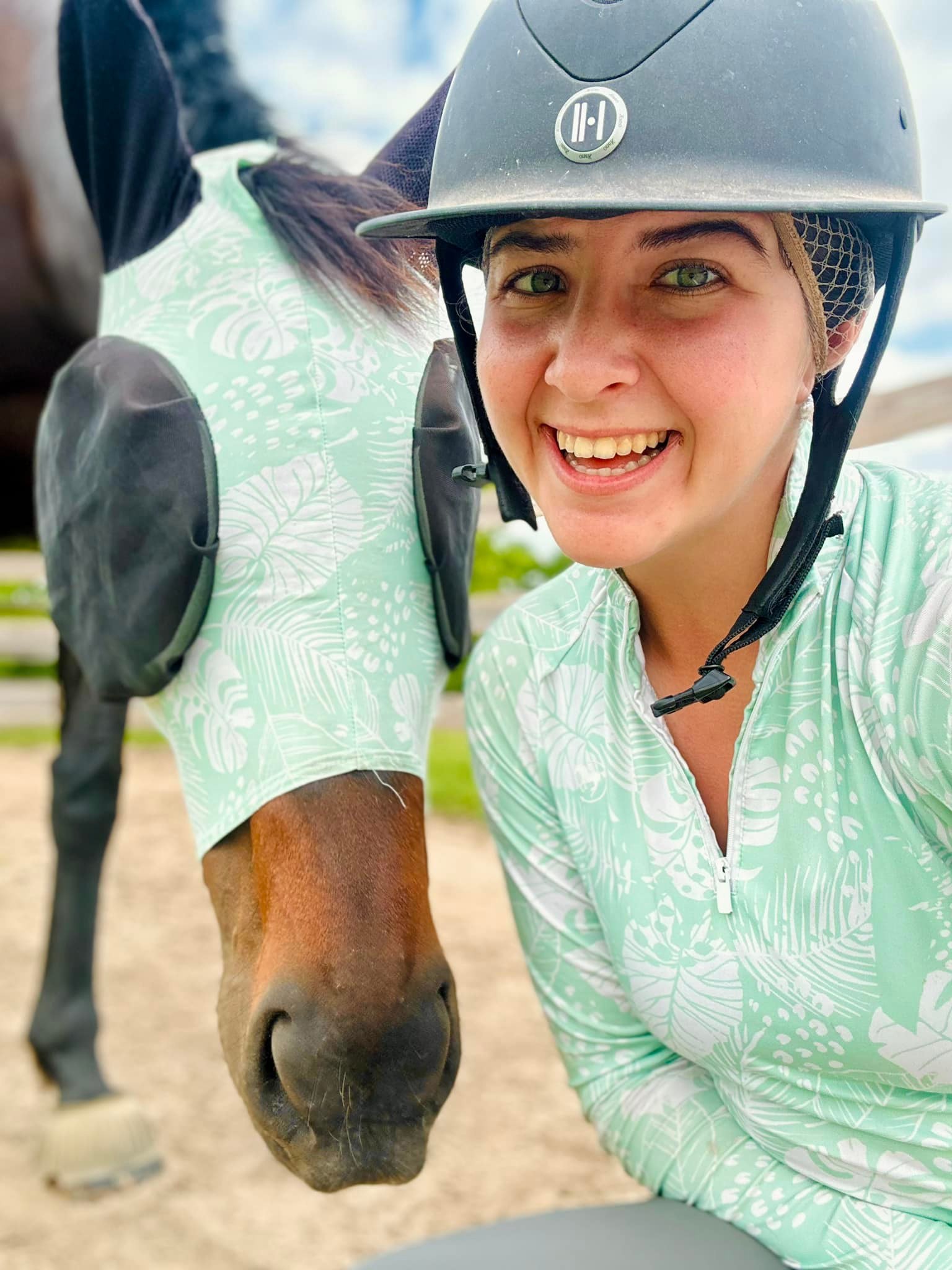
Your horse spooks at the tarp in the corner. Your heart rate spikes. Your breath stops. Your legs clamp. And now your horse — who was already on edge — has received confirmation that the tarp is, in fact, worth panicking about.
That loop is not a training problem. It’s a nervous system problem. And until you understand what’s actually happening between your body and your horse’s body in that moment, you’ll keep trying to solve it with leg pressure and contact adjustments that don’t touch the real issue.
Co-regulation is the mechanism behind why your calm becomes your horse’s calm — and why your anxiety becomes his too. It’s not a soft concept. It’s biology. And once you understand it, it changes how you ride, how you warm up, and how you handle the moments that used to unravel you.
What Co-Regulation Actually Means
Co-regulation is the process by which one nervous system influences another through proximity, rhythm, and physical cues. It’s how human infants self-regulate — by being held by a calm adult whose heartbeat, breath, and muscle tone signal safety. The infant’s system literally borrows from the caregiver’s.
Horses do this with each other constantly. Watch a herd when one horse goes on alert. The head comes up, the nostrils flare, the breath quickens. Within seconds, every horse within visual range has caught that signal. That’s co-regulation running in the threat direction.
But it runs the other direction too. A calm, grounded horse at the water trough, breathing slowly, ear relaxed — other horses near him settle. His system broadcasts safety.
You are in that equation. The moment you’re on your horse’s back, you are the most immediate nervous system input he has. Your breath rate, your muscle tension, your heart rate variability, your postural tone — he is reading all of it, all the time, through the seat of your pants and your leg contact and the tension in your hands. This is not metaphor. Horses have been shown to synchronize their heart rate variability with that of their riders, and to register elevated human heart rate even before the rider consciously realizes they’re anxious.
You cannot fake this. Your horse is not listening to your intentions. He is listening to your body.
The Three Channels Your Horse Is Reading
Understanding which channels carry the most information helps you know where to intervene.
1. Breath
Breath is the fastest and most powerful signal you can send. A held breath is a threat signal — it’s what every mammal does the instant before it either fights or flees. Your horse has evolved to read that cue at the level of survival.
When you inhale and hold before a fence, before a spooky corner, before a flying change you don’t trust — your horse gets the message before the obstacle comes into view. He doesn’t know you’re holding your breath because you’re nervous. He knows something worth stopping breathing for is happening.
A long, audible exhale is the opposite signal. It says: I have checked the environment. I have assessed the threat. There is no threat. My body is relaxing. You can relax too.
This is why “breathe” is not just a cliché. It is a direct communication tool.
2. Muscle Tone
Your horse feels your muscle tone through every point of contact — your seat bones, your thighs, your calves, your hands. Braced muscles feel different from soft muscles. Gripping feels different from weighting.
The problem is that in a nervous system activation state, muscle bracing is automatic. You don’t decide to grip. You grip. Your hip flexors shorten, your glutes harden, your fingers close on the reins. All of this happens before your conscious brain has processed the situation.
This is where riders get stuck. They’re trying to think their way out of a reflex. You can’t. You have to work through the body to change the body’s output.
The cue that works fastest for me — and for the riders I work with — is deliberately softening the base of the ribcage on the exhale. Not the arms, not the hands. The ribs. When you let your ribcage drop on the exhale, the thoracic spine softens, the shoulder blades drop, the elbows unlock. It’s a top-down release that travels through the contact and lands in your horse’s mouth and back.
3. Postural Weight
Where you carry your weight tells your horse what mode you’re in. A rider who is bracing back, chin forward, seat locked — that’s a rider who is preparing for something. A rider who is following, weighted through the pelvis, soft in the lower back — that’s a rider who is not anticipating a problem.
Horses are exquisitely sensitive to this distinction. They live in a world where postural changes in other animals predict events. A rider who is perpetually braced is, from the horse’s perspective, perpetually predicting something bad. Over time, that keeps the horse’s system chronically elevated — not because anything specific happened, but because the signal never says “we’re okay.”
The Direction This Can Go Wrong
Here is where I see it break down most often: riders who are working on their confidence start using co-regulation as a performance. They try to appear calm. They hold a neutral face. They think relaxed thoughts. And their horse still knows, because the body doesn’t lie.
Appearing calm is not the same as being calm. If your breath is still held and your hips are still locked and your hands are still tight, the signal your horse is receiving has not changed. He is not fooled by your expression.
This is why “just relax” is useless advice. The nervous system cannot relax on command. It relaxes in response to information — information that says the threat has passed, that the body is safe, that the situation is handled.
The work is not mental. It’s physiological. You have to actually change what’s happening in your body, and that requires tools, not willpower.
Practical Tools That Actually Work
These are the interventions I come back to consistently, both in my own riding and when I’m working with other riders.
The physiological sigh before a difficult moment. Two quick inhales through the nose — the second one slightly shorter and sharper — followed by a long exhale through the mouth. This is a clinically researched breath pattern that rapidly lowers heart rate. Do it before the corner. Before the fence. Before you pick up the reins after a bad moment. It takes four seconds and it works.
Deliberate jaw release. Clench your back teeth for two seconds, then let go completely. Most riders who are holding tension are also holding it in their jaw, and releasing the jaw has a direct effect on the rest of the neck and poll — in you, not just your horse. A tense jaw means a tense rider neck means a tense poll in the horse through the rein.
Walking with weight and swing. When things escalate — when your horse comes up, when you feel yourself tightening — the single best move is almost always to drop to walk, give the rein, and ride the walk like it matters. Not a shutdown walk. A forward, ground-covering walk where you consciously let your hips swing with the horse’s barrel. This reestablishes rhythm between your body and his. Rhythm is safety. It communicates: I’m here, I’m following you, and I’m not braced against you.
Anchor to something physical. Find one thing you can feel. The weight of the stirrup on your foot. The texture of the rein in your fingers. The movement of your horse’s back against your seat. When your nervous system is activated, your attention narrows and you lose your felt sense of the present moment. One physical anchor pulls you back into your body — which is the only place you can influence your horse from.
What This Looks Like Over Time
Co-regulation isn’t a fix for a bad day. It’s a practice. The riders whose horses consistently settle under them are not the riders who have no nervous system activation — they’re the riders who have built a habit of returning to their body, regulating their breath, and sending a clear, consistent signal.
Your horse will build an association over time. If every time you exhale and soften, things get easier, he starts to read that breath as a cue in itself. He learns that your settled body means nothing is coming. That association takes repetitions, not just good intentions.
This is also why working on your nervous system regulation off the horse matters. If you never practice breathing through activation, you won’t be able to access it when you’re sitting on an anxious horse at a competition and your heart rate is through the roof. The practice has to be built when the stakes are low.
I’ve gone deep on this topic — the science, the practical tools, and what it actually looks like in a training session — on The Elevated Equestrian podcast. If you want to hear more about how to build this capacity deliberately rather than hoping it shows up when you need it, that’s a good place to start. Episodes on nervous system regulation, rider confidence, and the horse-human connection live there, and they’re the conversations I keep coming back to.
Your horse is always asking the same question: are we safe? Your job is to have an answer in your body, not just your head.