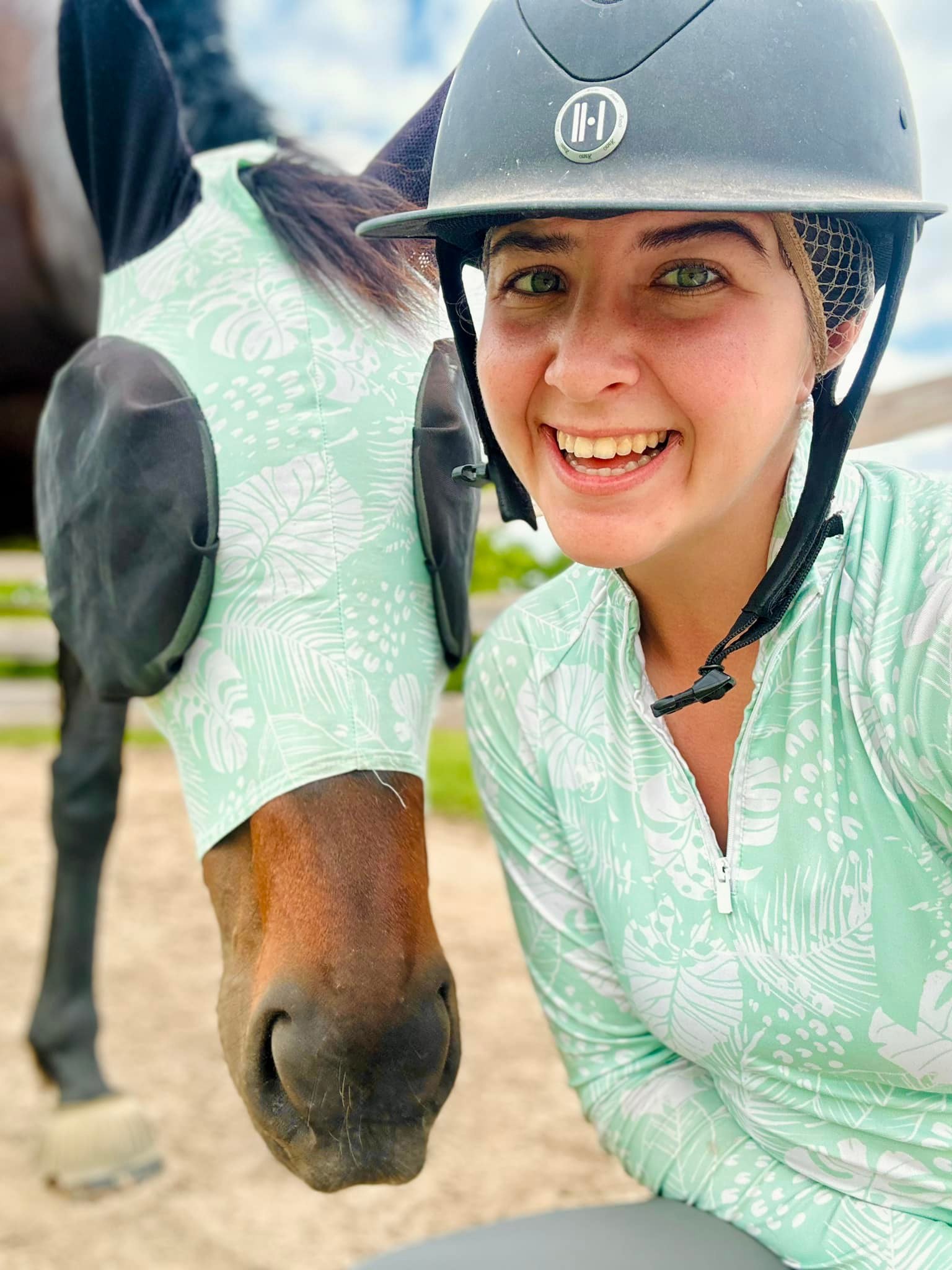
You turned him out after the last event of the season looking like an athlete. You brought him back in four weeks later and there’s a dip behind the withers you could set a coffee mug in. The pockets beside his withers are back. His spine is a little too easy to find. And when you put the saddle on, it sits differently than it did in September.
If your horse is hypermobile, none of that should surprise you. Loose-jointed horses lose topline faster than their tighter-built barn mates, and they lose it in a specific order. Most riders try to rebuild it in the reverse order. That’s why so many post-break comebacks produce a horse who looks round by Thanksgiving and is falling apart by the first spring outing.
This post is about the rebuild, not the break itself. If you’re still planning the time off, I covered how to protect topline in the first weeks back in an earlier post. This one is for the horse who already has the coffee-mug dip, and the rider who wants it gone for real.
What Actually Disappeared
“Topline” is a visual word for a structural problem. When you see that hollow behind the withers, you aren’t looking at one muscle that shrank. You’re looking at the end result of several systems letting go, roughly in this order:
- The deep spinal stabilizers. The multifidus muscles run segment to segment along the spine and keep each vertebra from shifting on the next. They respond fast to work and fast to rest, and they’re the first to go.
- The abdominals. The rectus abdominis and the obliques are the string on the bow. When they’re toned, they lift the back from underneath. When they soften, the back sags into the space they used to hold.
- The thoracic sling. The serratus ventralis and pectorals suspend the ribcage between the front legs. Lose them, and the chest drops between the shoulder blades. That’s your wither pocket.
- Only then, the visible back muscles. The longissimus is what riders stare at. It’s also the last piece of the picture, and it’s a locomotor muscle, not a support beam.
Here’s why the hypermobile horse falls further. A tighter horse has ligaments that carry some of the load when muscle tone drops. The supraspinous and nuchal ligaments do part of the holding. In a loose-jointed horse, that connective tissue gives more. When the muscle backs off, there’s less passive structure to catch him. He hangs in whatever he has left, and what he has left is stretchy.
So the dip you see is not just “he’s out of shape.” It’s a horse whose stabilizing system has gone quiet and whose passive system can’t cover for it.
Why the Usual Rebuild Backfires
The standard comeback plan goes something like this: lots of long-and-low, some hill work, a few weeks of poles, maybe a bungee or a pessoa to “encourage the topline.” For a lot of horses that works well enough.
For the hypermobile horse, it builds the shape without the structure.
Long-and-low chases a picture. A loose-jointed horse can drop his neck and stretch his nuchal ligament all day without his abdominals or his sling ever switching on. He looks round. He’s actually hanging off the front of his own spine.
Hills too early load a back that can’t hold. Trotting up a slope with soft abdominals means the hind end pushes into a back that sags under the effort. You get bigger hamstrings and a hollower horse.
Gadgets fix the head, not the trunk. Anything that holds the neck in place gives a hypermobile horse permission to stop organizing himself. He’s being propped, and propping is the opposite of what he needs.
Pole grids in quantity fatigue stabilizers that are barely online. A few poles are useful. Twenty minutes of them on week two is a recipe for a horse who starts tripping and leaning.
The principle is the same one that runs through everything I teach about these horses: stability before stretch, and the trunk before the limbs.
The Rebuild Order: Belly, Sling, Back, Neck
I don’t give hypermobile horses a fixed week-by-week calendar, because they come back at wildly different rates. I use markers. You don’t move to the next phase until the horse shows you the marker for the current one.
Phase One: Wake Up the Belly
Sessions are short, 20 to 25 minutes total, and most of the value happens at the walk.
- Belly lifts before you ride. Firm fingertip pressure on the midline of the sternum, just behind the girth, until you see the back rise. Hold three to five seconds. Three to five reps. If he can’t lift at all, that tells you exactly where you’re starting.
- Deliberate backing. Four to six slow, diagonal steps in hand, straight along a fence. Not rushed, not dragging.
- Neutral spine walk under saddle. Not long-and-low, not up and short. Poll roughly level with the withers, a soft and steady contact, and a walk that’s marching but not running. You want him carrying his own frame for five or six minutes at a time.
- Walk-halt-walk transitions where you feel his back stay up through the halt instead of dumping onto the forehand.
- Gentle hill walking if you have terrain. Here in Aiken that means the soft rises on the trails, not the steep stuff. Walk only. Straight up, straight down.
The marker: the belly lift is easy and visible, and he can hold a neutral spine walk without bracing or diving for the ground.
Phase Two: Rebuild the Sling
Now you’re asking the front end to carry itself. This is where most loose-jointed horses show you their weak side. They lean on the inside shoulder, brace through the back, and feel like they’re steering with their chest.
That’s the exact problem you have to address before trot work means anything. Small-angle leg yields, shoulder-in with honest bend and modest angle, and frequent transitions teach him to lift the ribcage instead of falling through the shoulder. If you want a guided version, the ride-along that walks through this exact suppling sequence, “Unlocking the Back of a Stiff Horse,” takes you through the neutral spine walk and trot, shoulder-in, leg yield, and transitions in a 16-minute warmup you can play in your ear. It’s built for the horse who braces and leans, which is the post-break hypermobile horse almost to the letter.
Keep the angles small. A hypermobile horse can give you more angle than he can support. Three tracks with a lifted shoulder beats four tracks with a collapsed one every time.
The marker: he can leg yield and shoulder-in at the walk and slow trot on both reins without the inside shoulder dropping or the contact getting heavier in one hand.
Phase Three: Load the Back
Now the trot work earns its place.
- Trot sets with walk breaks. Start with three to four minutes of trot, a minute of walk, repeat. Build the sets before you build the total time.
- Transitions within the trot. Shorten for eight strides, lengthen slightly for eight. The shortening is where the abdominals work hardest.
- Low cavaletti or single raised poles. Two or three passes per direction, not a grid marathon.
- Trot up gentle hills, now that the belly and sling can support the push from behind.
The marker: his back swings evenly at trot, he holds the frame through the end of each set, and the dip behind the withers has visibly started to fill.
Phase Four: Then the Neck and the Canter
The crest and the canter come last. A neck that develops before the trunk is decoration. Once the first three phases hold, canter sets and more uphill work will build the top of the neck honestly, because now it’s attached to a horse who’s carrying himself.
How to Know It’s Real
Riders fool themselves on topline all the time, because the horse looks better under saddle than he is. Track it objectively.
- Photograph him square, same spot, same angle, every two weeks. Side view and from above the withers, standing on a mounting block.
- Trace the withers with a flexible curve or a bent wire at the start of the rebuild and every few weeks after. The shape will change, and your saddle fit will change with it. Don’t wait for the fitter’s next scheduled visit if the tracing has moved.
- Watch the belly lift. If it gets easier and bigger, the foundation is building. If it stalls, you’re probably moving through the phases faster than he is.
Feed matters too. He needs adequate quality protein and amino acids to build anything. But no ration builds topline on a horse whose stabilizers aren’t being asked to work. Muscle grows in response to load, not to the feed bucket.
The Bigger Point
The fall break is necessary. These horses need real downtime after a season, mentally and physically. But the comeback is where the next season is decided, and the hypermobile horse doesn’t give you much margin. Rebuild him from the inside out and he comes into spring stronger than he left. Rebuild him from the outside in and you’ll spend the next season chasing the same dip.
I’ve talked through the stabilizer-first approach, and why loose-jointed horses need it more than anyone, on The Elevated Equestrian podcast if you want to hear more of the reasoning. For your rides between lessons, Sam’s ride-alongs are audio lessons you can play while you ride, so you’re not guessing at the sequence on your own.
If your horse came back from his break with a dip you can’t seem to fill, or you’re not sure which phase he’s actually in, that’s exactly what I sort out in lessons and clinics. We’ll look at where the stability is missing, build the rebuild order around your horse, and give you a plan you can ride on your own all winter. Reach out through the contact page to book a clinic spot or a lesson, and let’s get his topline back the right way this time.