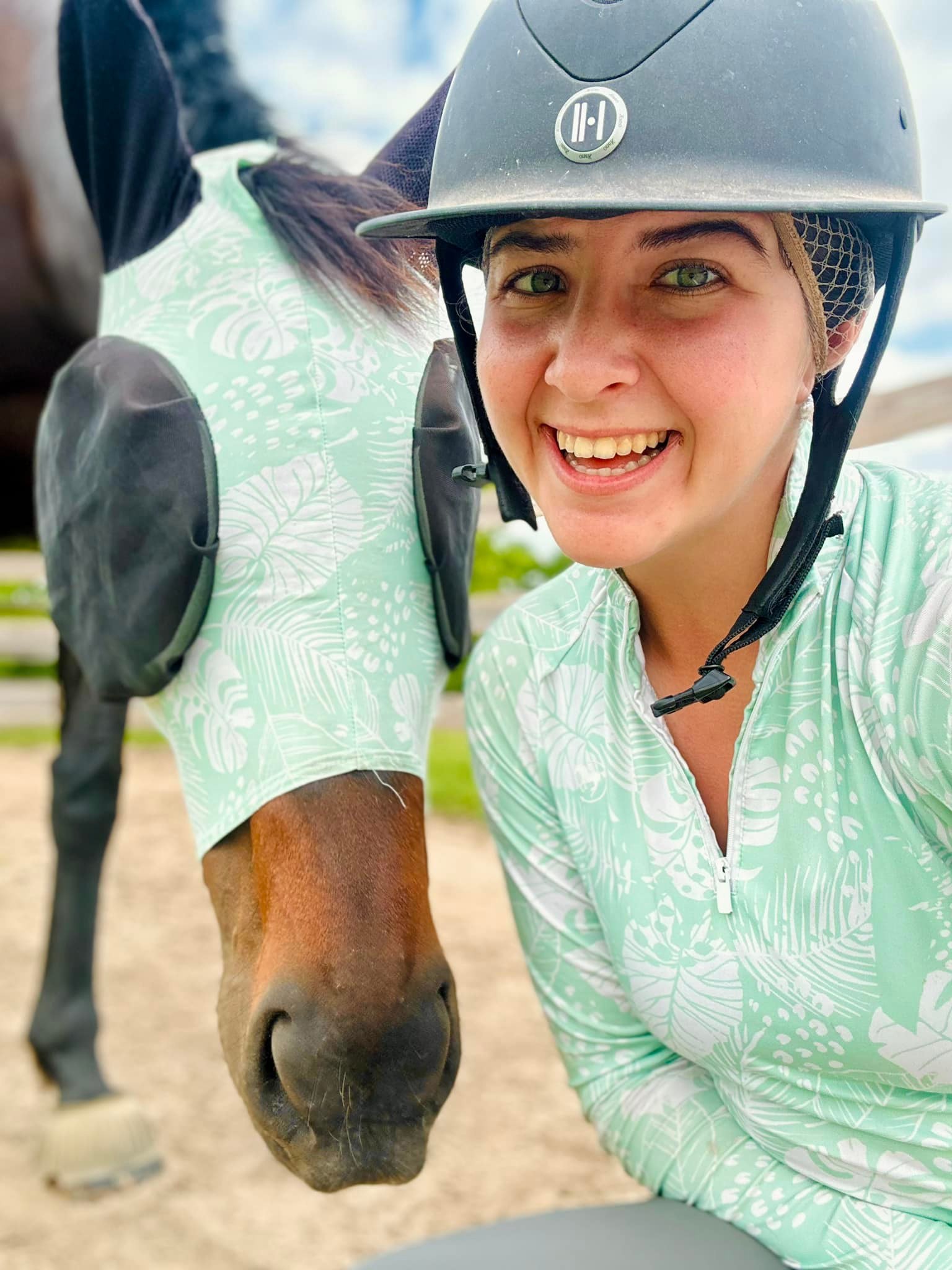
Fall mornings have a particular quality that every cold-backed horse owner recognizes immediately: the temperature drops fifteen degrees overnight, the horse comes in from the field tense across the lumbar, and the first few minutes under saddle are a negotiation you did not budget time for. Some horses express this as mild back-tightness that resolves in trot. Others are more theatrical about it. Either way, the warm-up question in fall is the same — how do you help a horse that is genuinely uncomfortable through the back get ready to work, rather than just waiting for him to work through it?
This is where routine matters more than any single product, but the right saddle pad is a meaningful part of that routine. I’ve been using the Benefab therapeutic saddle pads on horses that fit this profile, and here’s what I actually think.
This post contains affiliate links. If you shop through them I may earn a small commission at no extra cost to you — and you’ll get my reader discount. I only feature gear I’d actually put on my own horses or wear for a full day in the saddle.
What “Cold-Backed” Actually Means — and Why Fall Makes It Worse
Cold-backed is one of those barn terms that gets used loosely, but in practice it describes a horse that presents with a guarded, bracey back response in the early minutes of work — typically when the saddle goes on or when weight is first applied. The horse may dip away from the girth, be reluctant to move forward freely, show a flat or tight canter for the first few circles, or simply feel like he is holding his breath through the entire first five minutes.
This can have multiple contributing factors, and it is worth saying plainly: a saddle pad is not a diagnosis and it is not a substitute for a vet evaluation, a saddle fit check, or a proper bodywork routine if your horse is presenting with significant back discomfort. What a therapeutic saddle pad can do is support warmth and circulation through the back during the tacking-up and early warm-up phase, which is exactly when a cold-backed horse is most guarded.
In fall specifically, the combination of cooler ambient temperatures, tighter muscles from field time in cold air, and less consistent work schedules than summer creates a window where horses that were manageable in July become noticeably more reactive in October. Addressing that window with a consistent pre-ride warm-up routine — including what is on the horse’s back during that warm-up — is legitimate management.
The Benefab Therapeutic All-Purpose Saddle Pad: The Core Recommendation
The Therapeutic All-Purpose Saddle Pad ($99.95) is Benefab’s everyday-use pad, and it is the one I reach for first when talking about the cold-backed horse in fall. The fabric incorporates Benefab’s far-infrared technology, which the brand describes as encouraging circulation and warmth through the area it contacts. Practically speaking, many riders using this pad notice that their horses are looser and more willing to move through the back earlier in the warm-up session than they were with a conventional pad.
I want to be careful here about how I frame this, because it matters: the pad does not fix back soreness, and it is not a substitute for proper management. What riders consistently report — and what I’ve observed — is a behavioral shift. Horses that were characteristically tense for the first ten minutes of work settle faster. Whether that’s the warmth the fabric encourages, the tactile contact of the pad itself, or some combination is hard to isolate. What I can say is that for horses presenting with cold-backed behavior, adding this pad to the routine is an easy, low-risk step.
Fit and construction notes: The all-purpose cut is built for close-contact and all-purpose saddles — it is not going to work well under a dressage saddle with a deep rear flap, and it is not cut for a western tree. The pad is relatively slim-profile, which is worth noting if you have a saddle that already sits well on your horse. A bulkier half pad situation layered under this adds more height than many horses need. For most AP and close-contact fits, this pad works directly under the saddle without a half pad.
The pad is machine washable, which matters when you are using it daily through fall mud season. The fabric holds up well to regular washing — I have not seen the therapeutic properties described as degrading with washing in Benefab’s documentation, which is consistent with what users report over long use.
Who this suits: Horses with an all-purpose or close-contact saddle fit, riders doing a mix of flatwork and jumping, anyone building a daily warm-up routine for a back-sensitive or cold-backed horse. At $99.95, it is priced as a working pad, not a special-occasion piece.
Who it does not suit: Dressage riders — there is a dedicated pad for you, discussed below. Western riders — same. And if your horse has a significant saddle fit problem driving his back behavior, no pad is going to resolve that. See your saddle fitter before spending money on pads.
The Therapeutic Dressage Pad: Same Benefit, Correct Cut
If you ride in a dressage saddle, the Therapeutic Dressage Pad ($119.95) is the relevant option. It is the same Benefab therapeutic fabric in a square-cut dressage pad format. The $20 premium over the all-purpose version reflects the additional material in the larger cut, not a difference in the fabric or its properties.
Everything I described above applies equally here — the warmth-encouraging fabric, the circulation support through the lumbar region, the behavioral shifts riders notice in horses that are characteristically guarded through the back in cool weather. The cut is what changes.
Fit note for dressage riders specifically: the square pad format means it is designed to show evenly around the saddle flap. If you are using a half pad underneath, confirm your girth length before adding the additional lift — dressage pad plus half pad can require dropping a girth size, and this is worth checking before you are tacking up in the dark at 6 a.m. in October.
Ready to try the Benefab Therapeutic Saddle Pad? Use my link for reader benefits at Benefab → https://bit.ly/4uhqYoF
Adding Leg Support to the Fall Warm-Up Routine
The saddle pad addresses the back, but a cold-backed horse in fall is often expressing a whole-body stiffness — particularly through the hocks and hindquarters. If your horse is consistently slow to warm through behind as well as through the back, the Rejuvenate Smart Hock Boots ($119.95) are worth considering as a pre-ride layering piece.
The hock boots are designed for warmth and circulation support in the hock region — Benefab markets them for horses that present with stiffness in that area, which in fall often means the horse that takes ten minutes to track up properly behind, or the one that is characteristically flat in the canter until his hocks warm through. Used as part of a pre-ride routine — put on while you groom and tack up, removed before you mount — they give the hock area time to warm before work begins.
These are not a diagnostic tool. If your horse’s hind-end stiffness is worsening, is asymmetrical, or is new, that warrants a veterinary conversation rather than a change in boot routine. But for the horse that has been characteristically slow to warm behind for years and has been cleared by the vet, adding hock support to a fall morning routine is a practical step.
Practical note on the hock boots: They require correct fit around the point of hock — too loose and they slip, too tight and they are counterproductive. Benefab’s sizing guidance is based on the measurement around the hock joint itself. Measure before you order, particularly if your horse has large or small hocks relative to his overall size.
I’ve talked about building structured warm-up routines for the back-sensitive horse on the podcast — if you’re managing a horse like this through the colder months, that episode has more detail on the sequencing side of things.
The Western Option: Therapeutic Western Pad
For western riders — and this is a discipline where the cold-backed horse is just as common, even if the conversation happens in different circles — the Therapeutic Western Pad ($129.95) is Benefab’s answer. It comes in Black, Electric Blue, Royal Purple, Bubblegum Pink, and additional colors, which matters in a discipline where pad color is part of your turnout.
The western pad is built for the western tree and the coverage a western saddle requires, with the same therapeutic fabric throughout. At $129.95 it is the highest price point of the three saddle pad options, reflecting the larger format. Function and use case are identical to the AP pad — warmth, circulation support, part of a pre-ride routine for the cold-backed or back-sensitive horse.
How to Build the Routine, Not Just Buy the Product
The pad matters more when it is part of a deliberate routine than when it is simply a swap from your old pad. Here is how I would suggest building this into a fall morning:
Before you mount: Give the pad time to work while you groom, pick feet, and finish tacking up — that is fifteen to twenty minutes of contact through the back before you ever ask the horse to carry weight. Pair this with a slow, forward walk warm-up on a long rein for the first ten minutes rather than picking up contact immediately. The pad supports comfort during that window; the walk work activates the rest.
After work: The therapeutic fabric continues to be in contact during cool-down, which is also a relevant window for back-sensitive horses. Let the horse walk out under saddle rather than pulling the tack immediately — those last ten minutes of contact during cool-down matter too.
Consistency across the week: A horse that is cold-backed in fall usually benefits most from a consistent daily routine rather than an intensive single session. Shorter, more consistent warm-ups five or six days a week will do more than one long session after several days off.
The Bottom Line
The Benefab Therapeutic All-Purpose Saddle Pad is the place to start for most riders dealing with a cold-backed horse in fall. If you ride dressage, the Therapeutic Dressage Pad is the correct cut. Western riders should look at the Therapeutic Western Pad. And if your horse is stiff behind as well as through the back, layering in the Smart Hock Boots as a pre-ride piece rounds out a genuinely thoughtful fall warm-up routine.
None of these products replaces a vet evaluation, a saddle fit check, or a consistent training approach. But for a horse that is cleared and managed and simply needs more warmth and routine support through the colder months, this is a practical, well-made lineup worth adding to your barn.
Ready to build your fall warm-up kit? Use my link for reader benefits at Benefab → https://bit.ly/4uhqYoF