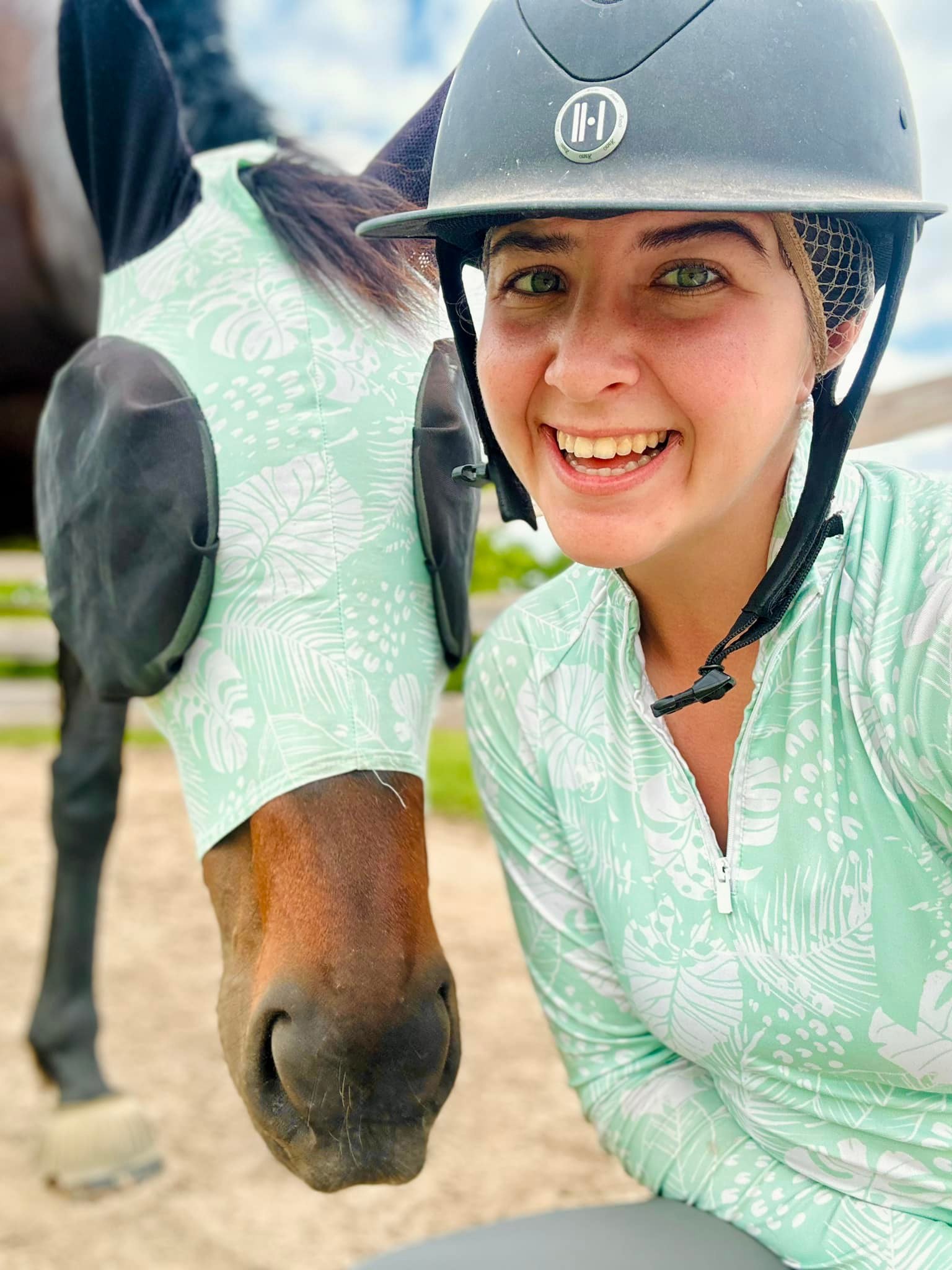
Riders ask me some version of this every week: “Should I get the SmartHood or the SmartMask?” Most of them already know they want something for the front end of their horse. What they don’t know is which piece matches their horse. The two products sit $100 apart and cover different parts of the horse. If you buy the wrong one, you end up with a nice piece of gear aimed at the wrong place. Here is how I decide, horse by horse.
This post contains affiliate links. If you shop through them I may earn a small commission at no extra cost to you — and you’ll get my reader benefits. I only feature gear I’d actually put on my own horses or wear for a full day in the saddle.
The Quick Comparison
| Rejuvenate SmartHood | Rejuvenate SmartMask | |
|---|---|---|
| Price | $179.95 | $79.95 |
| Coverage | Neck and shoulders | Face, poll, and head |
| Best for | The horse who is stiff through the neck and slow to bend | The horse who holds tension behind the ears and in the face |
| When I use it | Pre-ride warm-up, post-work cooldown, recovery days | Pre-ride settling, grooming time, quiet recovery sessions |
| Learning curve | Low for most horses | Moderate for head-shy horses |
| Skip it if | Your horse’s tension lives mostly at the poll | Your horse’s stiffness starts at the base of the neck |
Here is the short version. Look at where your horse holds tension, then buy for that spot. Don’t buy based on which one looks more complete.
Rejuvenate SmartHood: For the Horse Who Is Stiff From the Withers Forward
Price: $179.95
The Rejuvenate SmartHood covers the neck and shoulders. It uses Benefab’s therapeutic fabric, which works by reflecting the horse’s own body heat back toward the tissue underneath. The goal is warmth and circulation support across the big muscles that run from the poll back to the withers and down into the shoulder.
The horse it’s built for: He comes out of the stall looking like he slept on his neck wrong. He bends easily one way and like a two-by-four the other. He needs fifteen minutes of walking before he’ll stretch long and low. He feels short in the shoulder for the first few laps. If your notes from the ride say “tight in the neck, better after warm-up,” this is your horse.
How I use it: Mostly in two windows. First, before I tack up, while I’m grooming and picking feet. That gives me twenty to thirty minutes of warmth on the neck before I ask the horse for anything. Second, after work, once the horse is cooled out and dry, as part of the cooldown. On the horses who need it, I usually notice they reach into the contact sooner in the warm-up and settle more readily afterward. I’m not going to oversell the mechanism. The behavioral response is what I care about, and it’s consistent enough that I keep using it.
Fit notes: Put it on and check two places. First, the withers: the hood should lie flat, without pulling down onto the spine or gapping up off it. Second, the chest: any fastening should sit snug without restricting the horse when he drops his head to graze or eat hay. If you’re between sizes, check Benefab’s current size chart. For horses with big, cresty necks, I’d lean toward the roomier option rather than stretch the fabric tight. Therapeutic fabric works best when it lies against the coat. Pulled tight, it’s just compression.
Who it doesn’t suit: Some horses are perfectly loose through the neck but carry everything at the poll and jaw. They pin their ears at the bridle and brace behind the ears when you pick up the contact. For that horse, the SmartHood mostly misses the target, and you’d be paying $180 to warm muscles that aren’t the problem. It’s also not my pick for a horse who objects to anything going over his ears or head. Introduce it slowly, and if he truly hates it, don’t force the issue.
The honest tradeoff: It’s the more expensive piece, and it covers more area. That’s worth it when the neck is the issue. When it isn’t, it’s an expensive way to miss.
Rejuvenate SmartMask: For the Horse Who Holds It Behind the Ears
Price: $79.95
The Rejuvenate SmartMask is the targeted option. It covers the face and poll, which is where a lot of horses quietly store tension that never shows up in a neck stretch.
The horse it’s built for: The busy-mouthed horse, or the one who braces at the poll the second the reins come up. The one who is fussy to bridle. The one who clamps his jaw when the work gets harder. The horse who stands in the cross-ties with his head up and his eye hard. These horses often move fine through the body. Their tension sits right at the junction of head and neck, and that’s what the SmartMask is aimed at.
How I use it: As part of a settling routine before the ride. I put it on during grooming and give the horse ten to twenty minutes in it before I tack up. Many horses I’ve used it on soften visibly. The eye gets quieter, the head comes down, and they start licking and chewing. Some riders also use it on recovery days as a low-key session in the stall or cross-ties. In my experience, it’s one of the easier ways to give an anxious horse a few minutes of downshifting before you ask him to work.
Fit notes: Fit matters more here than with the hood. The mask should sit snugly over the poll without pressing on the eyes or rubbing at the base of the ears. Watch how it sits when the horse lowers his head, not just when he’s standing at attention. Check it again after the first five minutes. Horses shift masks around by rubbing their faces on their knees or the stall wall, and the rubbers will find a way.
Introducing it: Don’t slap it on a head-shy horse and walk away. Let him sniff it. Hold it against his neck, then his poll, then put it on for two minutes and take it off. Build up from there. Rushing the first introduction can make a head-shy horse more guarded around his head, which defeats the purpose.
Who it doesn’t suit: The horse whose stiffness clearly starts at the base of the neck or in the shoulders. The mask doesn’t reach there. It’s also a tough sell for the chronic face-rubber who won’t leave anything on his head. And like the hood, I treat it as a supervised, in-barn tool. It’s not something I leave on a horse unattended.
The honest tradeoff: It’s less than half the price of the hood, and for the right horse it’s arguably the higher-impact purchase. But it is targeted. If your horse’s tension is spread from poll to withers, the mask alone will feel like half a solution.
Ready to try the Rejuvenate SmartMask? Use my link for my reader benefits at Benefab → https://bit.ly/4uhqYoF
The Step-Down Option: Smart Therapeutic Poll Pad
If you suspect your horse is a poll-tension horse but aren’t sure yet, consider the Smart Therapeutic Poll Pad at $39.95. It’s a smaller commitment than the mask. It sits under the crownpiece of your bridle or halter and puts the same fabric right where the head meets the neck.
I’d choose the poll pad over the mask in two cases. One is the horse who won’t tolerate a mask yet. The other is the rider who wants the warmth there during the ride, not just before it. I’d choose the mask over the poll pad when the horse carries tension through the whole face, not just at the poll, and when you want a dedicated pre-ride settling session rather than something worn under tack.
Which Horse Gets Which: My Decision Rules
When riders bring me this question, I walk them through four checks:
- Watch the first five minutes of the warm-up. If the horse is stiff bending, short in the shoulder, and unwilling to stretch down, start with the SmartHood. If he’s bracing at the poll, busy in the mouth, and fussing with the contact, start with the SmartMask.
- Watch him at the bridle. A horse who’s difficult to bridle, raises his head, or clamps his jaw is telling you where he’s guarded. That points to the mask, or to the poll pad as a step down.
- Run your hand down the neck. A horse who flinches or tightens as you work down toward the withers is pointing at the hood. If he’s relaxed there but goes still and wary when you touch behind the ears, he’s pointing at the mask.
- Be honest about budget. If you can only buy one and the signs are mixed, I’d start with the SmartMask. It’s the cheaper experiment. And settling the horse’s head and poll often loosens up more of the neck than you’d expect.
Some horses legitimately want both. That’s usually the sport horse in steady work who holds tension everywhere from the ears back. For that horse, I use the mask first during grooming to settle him, then the hood afterward as part of the cooldown. That way he isn’t wearing both pieces at once while he’s still unsettled.
I talk about reading where a horse holds tension, and why it so often turns out to be somewhere other than where the rider assumed, fairly often on the podcast. It’s worth getting this right before you spend money on any of it.
The Bottom Line
The SmartHood and the SmartMask are not a good-and-better pair. They’re built for two different horses.
- SmartHood ($179.95): the horse who is stiff through the neck and shoulders, slow to bend, and needs a long warm-up before he loosens.
- SmartMask ($79.95): the horse who holds tension at the poll and in the face, is fussy at the bridle, and needs help settling before he works.
Neither one replaces a vet, a good fitter, a well-fitted bridle, or a sensible warm-up. Used as part of a deliberate pre-ride and recovery routine, though, both are tools I reach for confidently. The key is buying for where your horse actually holds tension, not where you assume he does.
Ready to try the Rejuvenate SmartHood or SmartMask? Use my link for my reader benefits at Benefab → https://bit.ly/4uhqYoF