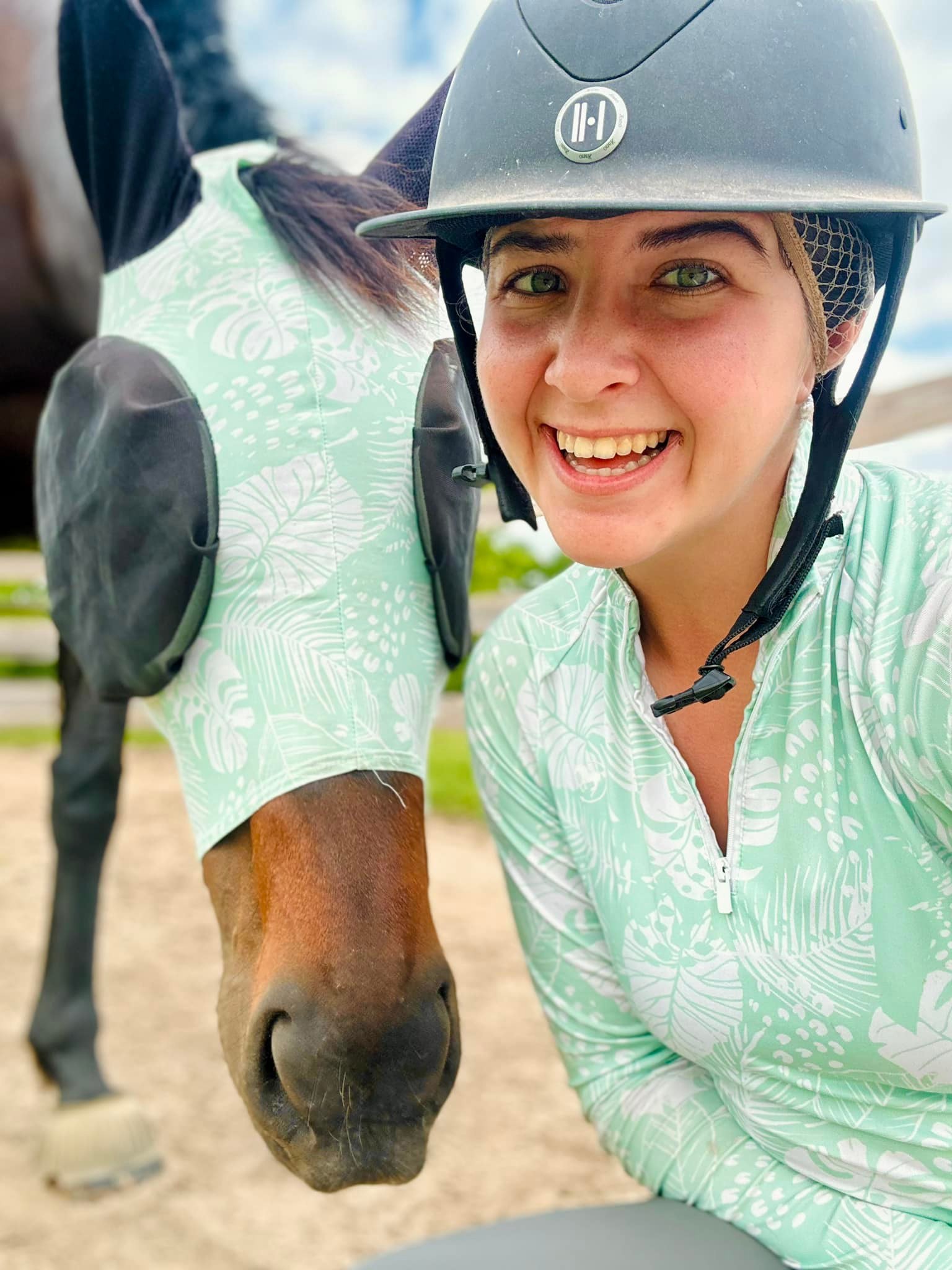
Every summer, this question lands in my inbox at least a dozen times: do I need a long-sleeve show shirt, or can I get away with short-sleeve? And the honest answer is that it depends on three things that most riders conflate — sun protection, rule compliance, and what judges actually care about. Get all three right and you can be comfortable in the ring without second-guessing your turnout at the in-gate.
Here’s the full breakdown, using the two show shirts I reach for most: the Amelia and the Cassidy.
This post contains affiliate links. If you shop through them I may earn a small commission at no extra cost to you — and you’ll get my reader discount. I only feature gear I’d actually put on my own horses or wear for a full day in the saddle.
The Quick Answer: A Comparison
| Factor | Long-Sleeve | Short-Sleeve |
|---|---|---|
| Sun protection at warmup | Better — covers your whole arm | You’re exposed from elbow down |
| Ring rules compliance | Safe across all disciplines and levels | Check your rulebook; some divisions require long-sleeve |
| Perceived polish in the ring | Traditional; preferred by many judges | Acceptable, increasingly common |
| Comfort in peak summer heat | Depends almost entirely on the fabric | Cooler in still air; no advantage in humidity |
| Under a show coat | Both work; long-sleeve has cleaner wrist line | Can look unfinished at the wrist under a fitted coat |
| Year-round versatility | Higher | Limited to warm months |
The short version: if you’re showing under a coat, long-sleeve almost always looks cleaner. If you’re showing in a discipline or division that permits short-sleeve and you’re not wearing a coat, short-sleeve is legitimate. The fabric matters far more than the sleeve length when it comes to actual comfort on a hot day.
The Sun Argument (It Favors Long-Sleeve More Than You Think)
Riders underestimate how much UV exposure they accumulate at shows. You’re not just in the ring for your test or your course — you’re waiting at the in-gate, hacking to the warmup, standing ringside between rounds. On a southern summer day, that’s 40 minutes to two hours in direct sun before you ever enter the ring.
A short-sleeve shirt exposes your forearm and elbow. A long-sleeve shirt in a modern cooling fabric covers everything without adding meaningful heat. I’ve talked about this on the podcast before: the difference between a bare arm and a covered arm in direct summer sun isn’t trivial, and the difference between a cotton long-sleeve and a technical-fabric long-sleeve is everything.
The Amelia — which comes in both long-sleeve and short-sleeve options — is built in a cooling, moisture-wicking fabric. On an 88-degree warmup day, I have not once finished a session in the Amelia long-sleeve and wished I’d gone short-sleeve. The fabric moves heat away fast enough that the sleeve coverage stops feeling like a disadvantage after about five minutes.
If sun is your primary concern, long-sleeve wins. Full stop.
The Rules Argument (Know Your Discipline)
This is where I see riders make the most preventable mistakes.
Dressage: At most recognized competitions, a collared show shirt with sleeves is expected. Short-sleeve is increasingly tolerated at lower levels, but it reads as underdressed to traditional judges. USEF rulebooks have historically leaned toward long-sleeve as the formal standard. If you’re at a schooling show, nobody will pin you for it. If you’re at a recognized show trying to make a good impression, go long-sleeve.
Hunters: Under a coat, the sleeve length is almost irrelevant — the coat covers it. But if you’re in a division that permits riding without a coat (some warm-weather modified rules allow this at shows with heat protocols), short-sleeve is clean and appropriate.
Jumpers: The rules are more relaxed. Short-sleeve collared shirts are common and fully acceptable. That said, many jumper riders still prefer long-sleeve because they’re spending significant time in the sun between rounds.
Eventing: Dressage phase defaults to the same formality as standalone dressage. Stadium and cross-country have their own norms; show shirts are less common there anyway.
The Cassidy in short-sleeve hits the sweet spot for jumper rings and less formal hunter divisions — structured collar, clean lines, professional without being overdressed for a fast-paced day. The Amelia in long-sleeve is my default for anything dressage-adjacent or anywhere I want to be bulletproof on turnout.
The Judges Argument (They Notice Less Than You Fear, and More Than You Hope)
Here’s the honest truth about judges and show shirts: they’re not looking for long-sleeve versus short-sleeve. They’re looking at whether your overall turnout is polished, intentional, and appropriate to the level. A wrinkled long-sleeve in a washed-out color that fits poorly is going to register worse than a crisp, well-fitted short-sleeve in a clean white or navy.
That said, two things do register:
1. The collar. It needs to lie flat and stay flat. Both the Amelia and the Cassidy have structured collars that do this without a collar stay or ironing ritual. This matters more than sleeve length.
2. The fit at the shoulder and arm. A long-sleeve that bunches at the elbow or gaps at the shoulder looks sloppy. A short-sleeve that shows significant sweat marks at the underarm registers as unprepared. Both are avoidable with the right fabric and the right fit.
On color: white and navy read as the most traditional and are safest for first impressions. The Cassidy in White is the cleanest white I’ve found at this price point — it doesn’t go grey after washing, and it doesn’t turn translucent in humidity. The Amelia in Navy or Hunter Green is my pick for anyone who wants something slightly less standard but still fully ring-appropriate.
Ready to try the Amelia or Cassidy? Use code ELEVATED10 with my link for 10% off at Free Ride Equestrian → https://shopfre.com/elevated10
The Amelia Show Shirt: Where It Wins
The Amelia is the more structured of the two. The collar is crisper, the overall silhouette is slightly more fitted through the torso, and the long-sleeve version has a clean wrist opening that sits well under a coat sleeve without bunching.
Who it’s for: Dressage riders, hunters under a coat, eventers in the dressage phase, anyone who wants a traditional show shirt that performs in the heat.
Fit notes: The Amelia runs true to size but the fitted torso cut means if you’re between sizes and carry width across the back or shoulders, size up. A shirt that pulls across the shoulder blade will undo the whole polished effect. The short-sleeve option works well for riders who want the structured collar and fitted look but are showing in contexts where long-sleeve isn’t required.
Colors worth knowing: Navy is the workhorse. Hunter Green is distinctive without being outlandish — it reads beautifully in an eventing or hunter ring. Ocean and Periwinkle are better for schooling shows or lower-key events where you want some color. The Raspberry is listed as a sale color and is worth checking availability.
Honest limitation: If you have a very short torso, the Amelia’s fitted cut can run long in the body. It’s designed to tuck cleanly and stay tucked, which is a genuine benefit — but it assumes you’re tucking it in. Wearing it untucked doesn’t work the way it does with a more relaxed shirt.
The Cassidy Show Shirt: Where It Wins
The Cassidy is slightly more relaxed than the Amelia. Not casual — it’s still a proper show shirt — but there’s a little more ease through the body, and the overall feel is less formal. This is actually an advantage in several situations.
Who it’s for: Jumper riders, hunters in less formal divisions, anyone who wants a show shirt that transitions naturally between warmup and the ring without feeling stiff. Also a strong pick for people who find the Amelia’s cut too fitted through the core.
Fit notes: The Cassidy is more forgiving on a range of body types. It’s still cut for riders — longer torso, room through the hip — but the slightly relaxed fit means it works for more people without sizing up. In the White, it is genuinely white, not ivory. In the Black, it’s clean and works for jumper and eventing contexts where black shirts are common.
Colors worth knowing: White is the anchor. Urban Bronze is having a moment and it’s legitimately flattering across a wide range of skin tones — it photographs well in both outdoor and indoor light. Pale Yellow is quieter than it sounds; it reads as a warm neutral in photos and is a good alternative if you find white too stark. The Navy and Black are reliable for disciplines where color reads as too casual.
Honest limitation: Because the Cassidy is slightly less structured, it reads as slightly less formal under a fitted dressage coat. In a hunter or jumper coat, this difference essentially disappears. But if your discipline defaults to formal, go Amelia.
Putting It Together: How I Actually Decide
If I’m showing in a dressage test or a hunter equitation class where turnout matters and I’m wearing a coat: Amelia long-sleeve, Navy or White. I want the collar structure and the clean wrist line.
If I’m doing a jumper day or a warmup-heavy eventing show where I’m in and out of the ring repeatedly in the heat: Cassidy, either sleeve length depending on the division, in White or Urban Bronze. The slightly relaxed fit is more comfortable over a long show day and the fabric performs just as well.
If I’m at a schooling show and I want something that looks intentional but doesn’t require me to overthink it: either shirt, short-sleeve, in whatever color I feel like. Both look polished enough that nobody is going to mistake you for underprepared.
The deeper point — and one I come back to on the podcast when we talk about mental prep for competition — is that your clothes should be one less thing to think about on show day. Both shirts do that job. Get the one that fits your discipline, confirm your rulebook allows your sleeve choice, and stop second-guessing it at the trailer.
Ready to grab the Amelia or Cassidy before your next show? Use code ELEVATED10 with my link for 10% off at Free Ride Equestrian → https://shopfre.com/elevated10